I'm Dylan, a Wellington based designer. I specialise in service design.
As designers we should place all people at the center of our design process in order to develop refined design.
My Work
Service Design
Accelerator
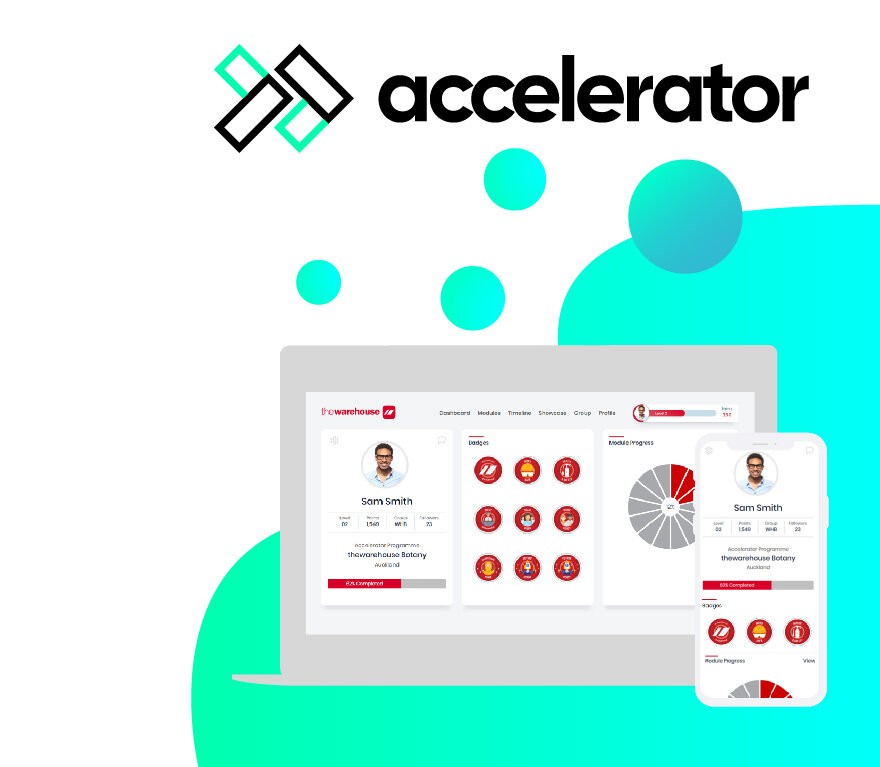
Accelerator is a digital platform for young people to access on-the-job training programmes and connect with employers in a blended learning environment that incorporates gamification, mentoring and the opportunity to experience work. Accelerator was built in collaboration between The Ministry of Social Development, The Warehouse and YouthHub.
As a part of this project I worked with all parties to develop the project to its current state. During this project I used my ability to draw together connections and nurtured relationships with these partners. Some of my responsibilities included developing and running interviews with participants to understand how the service could be improved, preparation and assisting run the operation of the programme and development of service design blueprints, surveys, behavioral interventions and service mapping.
Mana in Mahi - Strength in Work
Is a programme by the Ministry of Social Development designed to support young people into sustainable and meaningful employment. Pairing young people with employers to offer them both an industry training pathway and employment.
I had varied involvement in this project, from assisting developing assets for client workshops to designing a nudge messaging trial for clients.
Making Connections
- 3D Printing, Libraries And Augmenting Their Reality.
Digital technologies have initiated a global shift in the way we conceive, configure, and exchange information. This shift is occurring on many levels and is impacting the way many organisations operate; including Libraries.
This thesis speculates on what 3D printing and Augmented Reality can potentially be used for, through a series of design scenarios that simulate future possibilities.
The National Library of New Zealand Te Puna Matauranga o Aotearoa provided the context for this exploration and the opportunity to demonstrate how revisiting their collections with reference to these new technologies can empower its mandate to “collect, connect and co-create knowledge to power New Zealand” (National Library of New Zealand, 2015).
To do this three scenarios were created to explore how to make these connections. Creating different interactions between users and the collections as plausible strategies for The National Library to employ that engage new technologies along with re-invigorating collections. This thesis proposes near future scenarios of museum and library integrations for digital technologies, as it’s clear that digital technologies will play a significant role in the future of these institutions.
The thesis component of my masters gave me a great opportunity to push my design skills much further than before, tackling a large-scale design problem with a blue-sky approach to see just how far it could be pushed. It also allowed me to fully uncover my passion for creating experiences and crafting interactions. Being given the opportunity to develop my design research, 3D parametric modeling, 3D printing, design thinking, prototyping, scenario building and graphic design skills all in one project. The Masters experience set me up to look at problems with a wider perspective which I will cherish throughout my career I believe.
The 3D Digital Archive of the Future
The 3D Digital Archive of the Future is a VUW Summer Scholarship 2015 exploring the role of 3D media within the context of libraries. The summer scholars for this project were Dylan Hughes-Ward and Ryan Achten alongside Ruth Barnard contributing as a Research Assistant. Our research showed that 3D media is more effective in a library when it is used as a tool to aid learning, enhance narratives and encourage interactive engagement with existing archives.
We found that the most successful interactions with 3D printers were those that connect the user with digital media such as augmented reality, gesture interaction and other user interactive media as they enable visitors to engage playfully within the library space while discovering and learning.
Four main scenarios were developed and video demonstrations of these were created. The end result of this summer scholarship resulted in an exhibition of the scenarios at the National Library.
The opportunity to work closely with the National library to produce speculative scenarios to push the use of technology within the library was exciting and allowed me to have my say within the team and alongside senior lecturers. I was leading the work on the topic of 3D modeling and printing, brainstorming with the other scholars and contributing to the filming of the many videos we produced.
Skin Deep
Skin Deep is a speculative service design that uses medical scans to physically visualise injuries as jewelry.
Skin Deep uses medical data and parametric modeling to turn your broken bone, blood clot or muscle tear into an external illustration as a wearable piece of art.
Sharing your bravery or reckless abandon for safety with those around you, taking what was once taboo to ask about and celebrating it.
Skin Deep allows you to take control of your data allowing you to customise a piece of jewelry that showcases your body and what your injury meant to you.
Giving you the opportunity to make a ring, bracelet, pendant, earrings or even body piercing jewelry.
“This Platform will provide an online space for young people to access a range of fun and interactive job training modules. ”
– Hon Carmel Sepuloni.
Graphic Design
Little book of Pinot
The little book of Pinot has been developed as a pocket sized wine diary.
13104
13104 is a project visualising my movements over a year and a half. The visualisation was created by using google location data from my phone, running it through excel, grasshopper and illustrator to generate the illustration.